
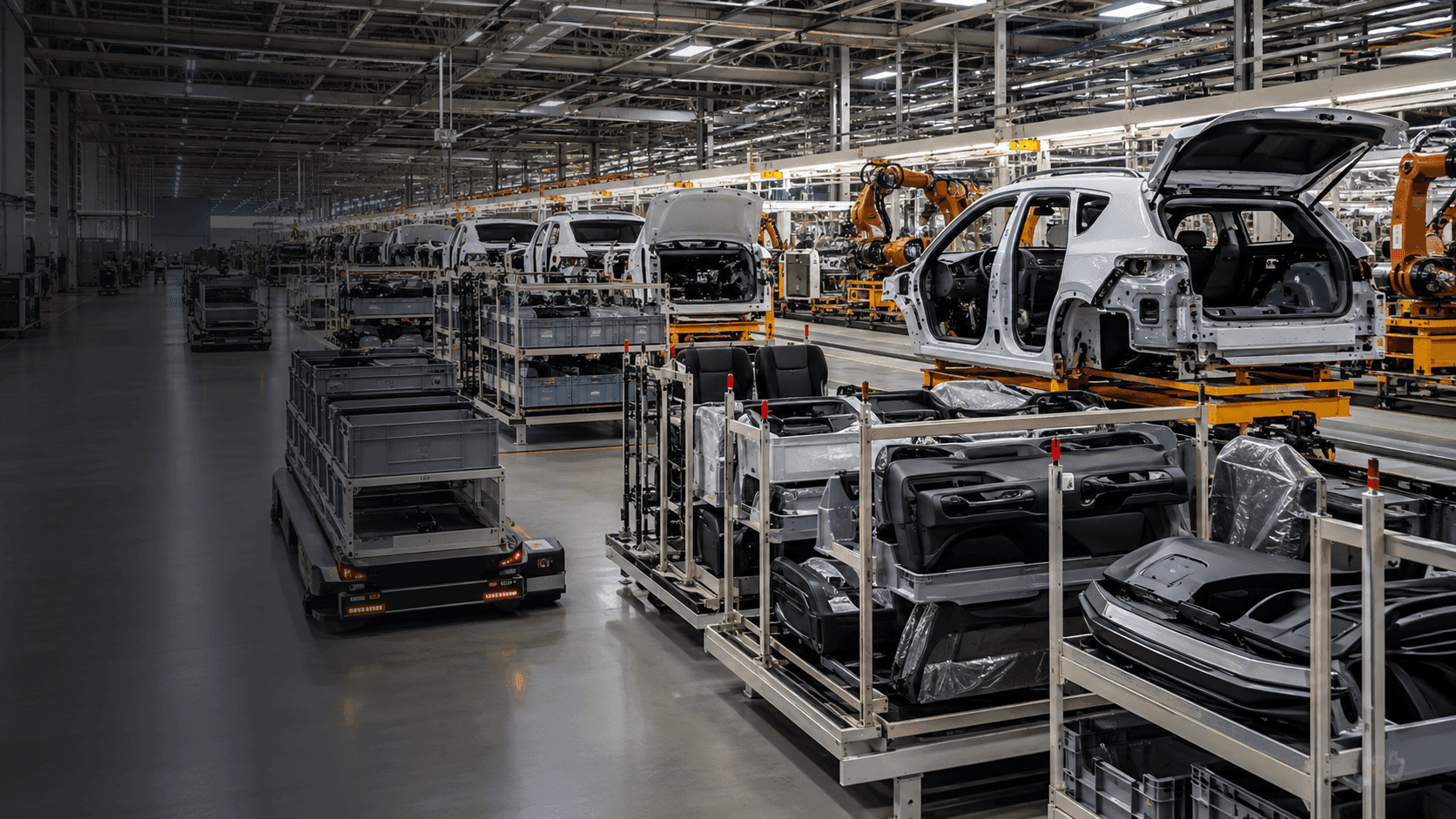
JIS/SILS Sequencing & Supply
Build and deliver in the exact sequence the OEM will consume — every unit, every shift.
No obligation — we'll walk through your needs, free of charge.
Just-In-Sequence (JIS) and Supply-In-Line-Sequence (SILS) are unforgiving disciplines. The OEM broadcasts a sequence; the supplier has minutes to hours to build the right variant, in the right colour, with the right components, and put it on the truck in the exact order the assembly line will consume it. Miss the sequence and you stop the line — a mis-sequenced part is worse than no part at all. Qmuzik JIS/SILS Sequencing & Supply is engineered for that reality: decode the sequence signal, slot it onto the line, protect it through every station and prove it, unit by unit, to the OEM.
Sequence is the product
In JIS/SILS the physical part is only half the deliverable. The other half is the sequence itself — its integrity, its timing and its provability. Qmuzik treats sequence as a first-class object across planning, execution and dispatch.
Minutes
From OEM broadcast to line
Not shifts, not days
100%
Sequence accuracy target
1
Sequence of truth
Broadcast → build → dispatch
Line-stop
What a sequence break costs
The sequence signal, decoded
OEM broadcasts arrive as EDI, XML, JSON or a custom pull signal — every account is different. Qmuzik decodes each format into a normalised sequence call: VIN or sequence number, variant, colour, options, delivery window, tempo. From that moment on, every downstream decision — routing, materials, labour, dispatch — is driven by the same call.
Book a walkthroughCapabilities
Everything needed to receive, build, protect and prove the sequence — natively integrated with planning, production, quality and dispatch.
Sequence signal handling
Receive EDI, XML, JSON and custom OEM broadcasts. Decode into a normalised sequence call: VIN, variant, colour, options, delivery window, tempo.
Broadcast to build slot
Every incoming call is provisioned as a build slot with a routing, a materials list, a station queue and a target delivery window — automatically.
Rolling sequence queue
Live view of the next N units, where each one is in the routing and which are ahead of, on or behind tempo — by cell, line or plant.
Variant and colour discipline
Right VIN, right colour, right trim, right options — every time. Component selection is driven by the decoded call, not by an operator guess.
Kanban, kitting and repack
Sequenced repack cells, kitting bins and sequence trolleys are managed against the sequence call — with pull signals and replenishment triggers.
ANDON and mis-sequence alerts
Sub-second alert if the sequence is broken at any station. The line is protected before a mis-sequenced unit ever reaches the dispatch dock.
Sequenced dispatch and labelling
Every unit ships with the OEM-expected label, sequence number, ASN and manifest — verified against the broadcast before the truck closes.
Delivery windows and tempo
Production tempo is matched to the OEM line tact. Windows, milk-runs and dock schedules are managed against the same sequence, not a spreadsheet.
Traceability of the sequence
Every VIN, every serial, every station, every operator and every component is recorded against the sequence call — from broadcast to delivered unit.
How it works
From OEM broadcast to delivered unit — six steps, one sequence.
- 1
Receive
EDI, XML, JSON or custom pull signals are decoded into a normalised sequence call — VIN, variant, colour, options, window, tempo — and dropped onto the rolling queue.
- 2
Slot
Every call gets a build slot: routing, station queue, materials list, kitting and dispatch dock — provisioned automatically against the sequence.
- 3
Build
The sequenced work order is issued to the station with a pull signal. Components, labour and tooling are all selected against the decoded call.
- 4
Verify
Sub-second sequence check at every downstream station. A break triggers an ANDON before the unit is allowed to advance.
- 5
Ship
Sequenced dispatch: OEM label, sequence number, ASN and manifest are verified against the broadcast before the truck closes.
- 6
Prove
Full audit trail per sequence number — every VIN, every serial, every component, every operator — reconciled back to the original OEM call.
One sequence break costs more than a month of savings
A single mis-sequenced unit stops the OEM line. The chargeback dwarfs any margin the shift produced. Qmuzik protects the sequence at every station, with hard interlocks against the decoded call — because the cheapest sequence break is the one that never leaves the plant.
Explore Qmuzik EnterpriseWhere JIS/SILS lives
The discipline was born in automotive tier-one supply, and shows up wherever a downstream line demands sequenced input.
Common questions about JIS/SILS on Qmuzik
Which OEM broadcast formats are supported?
EDI (VDA, ODETTE, ANSI X12), XML, JSON and custom pull signals — configurable per account. Every format is decoded into the same normalised sequence call, so downstream logic is common.
How is a sequence break detected and handled?
Every station verifies the unit against the decoded call before allowing it to advance. A mismatch triggers an ANDON immediately, blocks the transaction and routes the unit into a defined recovery flow — with the deviation logged against the sequence number.
Can it integrate with the OEM ASN and label system?
Yes. ASN and label formats are configurable per OEM account and are generated from the same sequence call that drove production, so the shipped label always matches what the OEM expects.
Can we run JIS/SILS and traditional make-to-order in the same plant?
Yes. Mixed-mode is native to Qmuzik. Sequenced lines, traditional make-to-order and engineer-to-order operations can coexist in the same install, each configured to match its own discipline.
How does sequence tempo align with the OEM line tact?
Tempo is a first-class property of the sequence call. Qmuzik plans and schedules against the OEM tact, matches production cadence to it and flags any drift against the rolling queue in real time.
What if a delivery window is missed?
The missed window is captured against the sequence number, the recovery flow is triggered and the OEM interaction (repackaging, expedite, chargeback record) is handled inside the same system that ran the build — no separate spreadsheets, no reconciliation later.
Does component traceability follow the VIN?
Yes. Every component consumed against a sequenced work order is recorded with its lot or serial and is retrievable per VIN, per sequence number or per shipment — indefinitely.
See JIS/SILS on your OEM account
Bring a real broadcast to the walkthrough — a sample EDI feed, an ASN template, a sequence file. We will decode it live and show you the build queue, the station protection and the sequenced dispatch — running.
No obligation — we will walk through your needs, free of charge.