
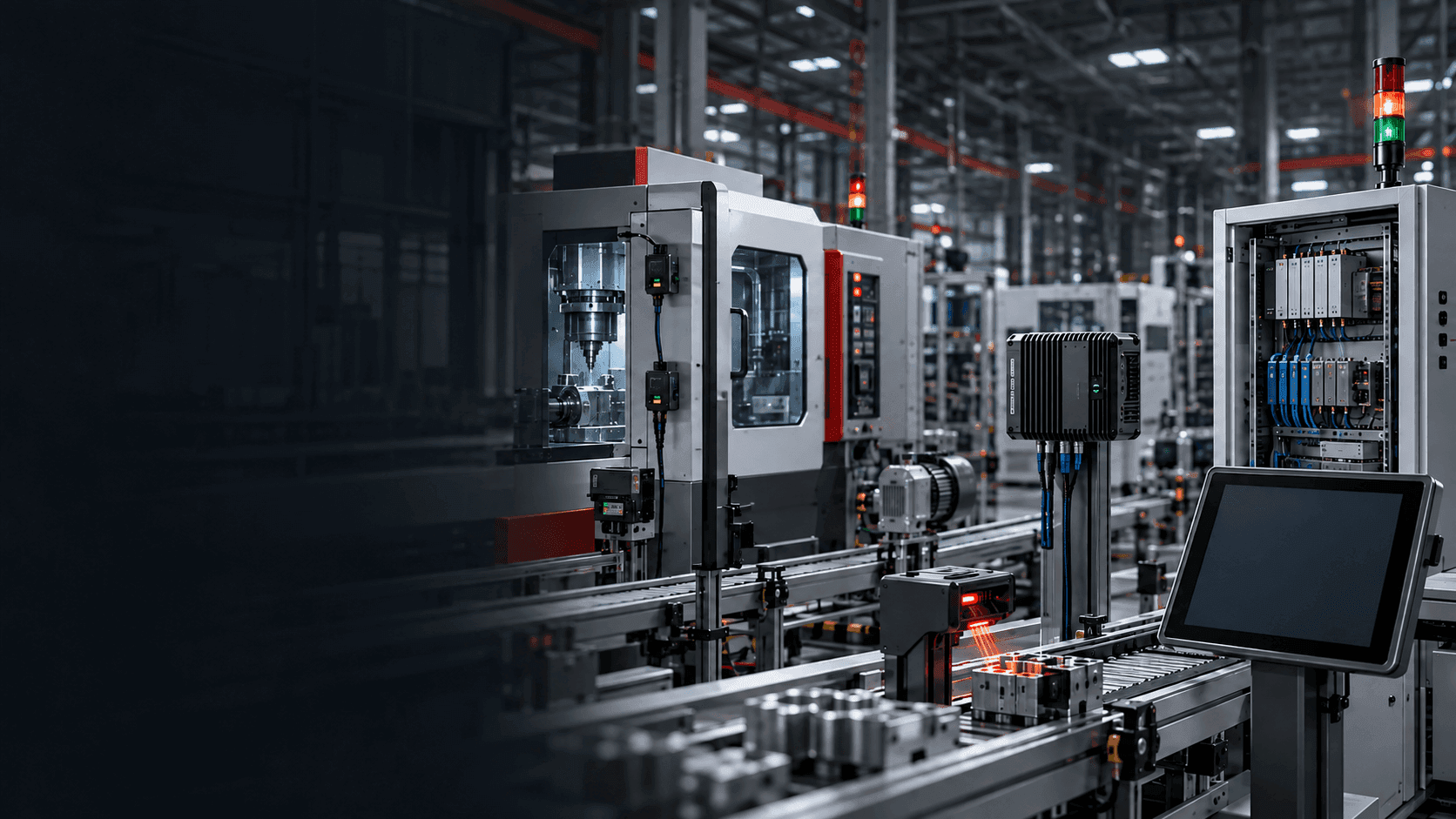
IoT & Smart Device Integration
PLCs, scales, cameras, scanners, beacon lamps — every smart device on the floor as a live actor on the business record, with two-way handshake, poka-yoke control and per-cycle traceability.
No obligation — we'll walk through your needs, free of charge.
An IoT integration that only reads a PLC is a fancy chart. The value only shows up when the device is allowed to act — start a cycle, refuse to start one, flash the amber lamp, capture the image, back-flush the material, hold the serial for containment — and when those actions are governed by the same business record that plans, produces, ships and bills. Qmuzik integrates PLCs, scales, vision cameras, HMI scanners, final-inspection scanners and beacon lamps as first-class actors on the enterprise record. Every cycle is validated live against the open work order, the allocated raw-material batch and the poka-yoke rules for the station. If the validation fails, the station does not start. If the cycle runs, it is logged — with tool, operator, part, serial, camera result, cycle time, PLC data-block values — against the referenced work order in the same moment it happens. Nothing is reconciled later. Nothing is inferred from a paper sheet.
The integration surface
Smart devices on the shop floor speak their own protocols and their own dialects. Qmuzik's middleware turns each of them into a first-class actor on the same business record — with a two-way handshake, live validation, and per-cycle traceability. What the device sees, the enterprise record sees, at the same moment.
TCP/IP
Ethernet PLC handshake
Native heartbeat + data-block reads and writes
Two-way
Devices act on the business record
Not just read — start, stop, enable, disable
Per-cycle
Traceability, image capture, PLC values, timings
Retained against work order, tool and serial
Poka-yoke
Station is disabled until the check passes
Wrong batch, wrong tool, empty stock — no cycle
The device is a first-class actor, not a chart
Most industrial IoT stacks stop at the dashboard — they read data, plot it, alert on it. That is not enough on a real production line. The Qmuzik middleware treats each connected device as a client of the business record: the PLC does not just report cycles, it asks permission to run one; the vision camera does not just capture an image, it commits a pass/fail against the serial; the beacon lamp does not just blink, it reflects the actual station status determined by the business rules. The device is not observed — it participates.
Book a walkthroughWhat the middleware integrates, and how
Ten integration patterns proven on real automotive lines — injection moulding, ultrasonic welding, camera inspection, scale-based dispensing, scanner-driven identification. Each pattern turns a smart device into a live, governed actor on the enterprise record.
PLC handshake over Ethernet
Two-way TCP/IP connection to the machine PLC — heartbeat monitored both ways, data blocks read for cycle counters, timings, tool numbers, serial numbers and part numbers, outputs written back for station enable, station disable and traceability override.
Vision camera capture per cycle
Camera images captured at the exact moment of the cycle and stored on an assigned server against the work order, part and serial. Pass / fail (Camera OK / Camera NOK) is committed to the enterprise record inline; images stay retrievable per serial indefinitely.
Poka-yoke station control
The station is not allowed to run until every configured check passes — right tool, correct variant, allocated raw-material batch, sufficient stock, valid operator. If any check fails, the middleware writes the "Station Disabled" output to the PLC and the machine will not start.
Scale and dispensing integration
Bench and floor scales read live over serial or Ethernet, tolerances validated against the recipe or work-order spec, dispensed quantities committed against the operation. Under- and over-dispenses handled inline; the transaction is never a guess.
Scanner identification (HMI + final inspection)
HMI scanners at the operator position identify the tool, variant and operator; final-inspection scanners confirm the serial before the part leaves the station. Tool references can also arrive from the PLC via a HARTING plug — the middleware treats both routes identically.
Beacon-lamp state reflects the business rules
Solid green means the station is enabled by the business record; flashing amber means the final inspection needs attention; disabled means at least one check has failed. The lamp on the pole is not a decoration — it reflects the current business decision.
Raw-material batch validation
Before a cycle can run, the middleware confirms that a raw-material batch is allocated to the machine and that sufficient stock remains for the run. Depletion during the cycle triggers a station-disable and the operator is prompted to allocate the next batch — before the wrong material is used.
Cycle logging with full context
Every cycle is logged with cycle time, PLC data-block values, tool, part, serial, operator, station, camera result and outcome. Retrievable per unit, per shift, per tool, indefinitely — for audit, for containment, for OEE analysis.
Configurable per station, per line
Connection settings, station name and version, camera file path and format, image-save delay, data-block references, scanner ports, PLC IP address, tool-number behaviour — every parameter is maintained in a single Settings screen, per station. Deploying a new line is configuration, not code.
Live signal view for engineering
A Machine Signals screen shows PLC inputs (heartbeat, manual / semi-auto / full-auto, cycle OK, override, purge, camera OK/NOK) alongside middleware outputs (station enabled / disabled, traceability override) and beacon-lamp outputs — plus memory statistics, so engineering can diagnose without touching the plant.
How a device becomes part of the business record
From tool identification to committed cycle — six steps, executed once per cycle, at machine speed.
- 1
Identify the tool and variant
The injection tool reference arrives either from an HMI scan or from the PLC through a HARTING plug. The tool identifies the variants that may be produced with it; the operator picks one, or the PLC dictates it.
- 2
Validate against the business record
Qmuzik runs the configured poka-yoke checks — is the correct raw-material batch allocated to this machine, is there sufficient stock for the batch, is the operator authorised, is the tool valid for the variant. Every check is live against the enterprise record.
- 3
Enable or disable the station
If every check passes, the middleware writes "Station Enabled" to the PLC and the beacon-lamp output goes solid green. If any check fails, the "Station Disabled" output holds the machine — no cycle can start until the operator resolves the exception.
- 4
Run the cycle
The machine runs its cycle. The middleware reads cycle-start and cycle-end signals from the PLC, captures the required camera image at the configured delay, and records the PLC data-block values — cycle time, tool number, serial number, part number.
- 5
Commit against the work order
The cycle is committed to the enterprise record against the open work order — quantity produced, material consumed (back-flushed from the BOM), camera pass/fail, operator, station, shift, timestamp. Nothing is deferred.
- 6
Reflect the outcome
Beacon lamps update to reflect the new state — solid green if the next cycle is authorised, flashing amber if final inspection needs the operator, disabled if the next check has already failed. The next cycle starts from a known-good position, or it does not start at all.
Stop the line before the defect leaves the station
The point of integrating a device is not to log its data — it is to change what happens next. A camera that only reports pass/fail is a chart. A camera that, on a fail, holds the serial, keeps the beacon amber, prevents the operator from advancing until the containment path runs, and marks the batch for re-inspection — that camera is doing real work. Qmuzik connects the pass/fail to the business rules, and the business rules to the station outputs, so the line stops before the bad part leaves the cell. Every cycle is either right, or it is contained. There is no third option.
Explore Qmuzik EnterpriseWhere device integration earns its keep
Anywhere the shop floor moves at machine speed and the business record has to move with it — plant-level PLC handshake, per-cycle image capture, in-line poka-yoke, scale-driven dispensing and scanner-driven identification.
Common questions about IoT & Smart Device Integration
What kinds of devices do you integrate with?
Machine PLCs over Ethernet / TCP-IP (heartbeat, data-block read/write, discrete outputs); vision cameras (per-cycle image capture with pass/fail); bench and floor scales (serial and Ethernet); barcode / RFID scanners at the HMI and at final inspection; HARTING plug tool identification; beacon lamps (solid green, flashing amber, red-disabled). New device classes are added as middleware adapters, configured per station.
Is the integration read-only, or does the device actually act on the business record?
It acts. The middleware writes station-enable and station-disable outputs to the PLC based on live poka-yoke checks; it drives beacon-lamp outputs to reflect the current state; it commits camera pass/fail and cycle data against the open work order. Read-only integrations are chart-fodder; Qmuzik integrations govern what the station is allowed to do next.
What is poka-yoke station control, in practice?
Before a cycle is allowed to run, the middleware validates a configurable set of preconditions against the business record — correct tool, correct variant, allocated raw-material batch, sufficient stock, authorised operator, valid station configuration. If every check passes, "Station Enabled" is written to the PLC. If any check fails, "Station Disabled" is written and the machine will not start until the exception is resolved on the operator interface.
How does per-cycle image capture work, and where are the images stored?
The middleware reads the cycle signal from the PLC, waits the configured image-save delay, requests the frame from the camera and stores the image against the cycle on the configured server path. The image is committed alongside the cycle log — work order, part, serial, operator, camera pass/fail — and stays retrievable per serial for as long as retention policy requires.
What if the network drops, or the PLC stops responding?
The PLC heartbeat is monitored both ways; a heartbeat failure disables the station until the connection is restored. Cycle logs and camera images are queued and committed once the link is back. The middleware never fabricates a cycle it did not observe — the ledger is only ever behind reality, never ahead of it.
What data blocks and signals do you expose?
Inputs read from the PLC typically include Heartbeat, Manual / Semi-Auto / Full-Auto, Cycle OK, Override, Purge, Camera OK, Camera NOK — plus data-block references for cycle counters, cycle durations, tool number, serial number and part number. Outputs written from the middleware include Heartbeat, Station Enabled, Station Disabled, user Traceability Override, forced Traceability Override, plus beacon-lamp outputs. The full signal map is exposed on the Machine Signals screen for engineering.
How is a new station or line configured?
Through a single Settings screen per station: database server + credentials, scanner communication ports, station name and software version, camera file path / image storage path / image format / image-save delay, data-block references, PLC IP address and tool-number behaviour. Deploying a new station is configuration, not code — provided the device class already has an adapter.
Can we integrate scales and other simpler devices, not just PLCs?
Yes. Scales are integrated over serial or Ethernet with the same pattern — the reading is validated against the recipe or work-order tolerance, and the dispense is committed against the operation. The same middleware pattern extends to torque tools, tag printers, RFID gates and other single-purpose devices, each treated as a first-class actor on the record.
What can we audit after the fact?
Every cycle is retained with cycle time, PLC data-block values, tool, part, serial, operator, station, camera result and outcome. Camera images are retained against the serial. PLC signal history is available for engineering diagnosis. Retrievable per unit, per shift, per tool, per station, indefinitely — for audit, containment analysis, OEE and warranty investigations.
See a device drive the business record on a live station
Bring a real problem to the walkthrough — a PLC that only reports, a camera whose results never reach the ledger, a scale that lives on paper, a station that has no way to be stopped. We will show a running Qmuzik middleware talking to a real PLC and camera, poka-yoke-holding a machine, and committing every cycle against a live work order.
No obligation — we will walk through your needs, free of charge.